Shipped Lycia AI end-to-end โ the autonomous guest agent now deployed in hotels, airports, malls, restaurants, and offices. This portfolio walks the journey, the live product, the pivot to a multi-sided revenue model, the customer outcomes, and the expansion plan that comes next.
How this product began, what we ran into, and what it became.
Lycia AI started as a guest-facing autonomous agent. The thesis was simple: hotel staff are stretched thin, guests want immediate answers, and a domain-trained AI sitting on top of the existing tech stack could close that gap without forcing a rip-and-replace. We built the agent end-to-end โ voice, chat, multilingual, integrated to the hotel's PMS โ and brought it to market.
The product worked. Customers shipped it, guests used it, and the metrics moved. But on the way to market we ran into the same wall over and over: the long tail of independent 5โ50-room hotels โ the hotels that would benefit most from autonomous staff augmentation โ often didn't have a PMS to integrate with. Our overlay model required a system that, for half our potential market, wasn't there.
We resolved it in two moves. First, we leaned into what was already working โ the hotel deployments โ and re-pointed the revenue model so the agent didn't sit alone. Hotels run Lycia for free; revenue comes from commissions when the agent recommends and books at restaurants, music venues, and activities in its network. The product becomes a multi-sided commerce engine, and every new participant makes the network more valuable for everyone already in it.
The second move is the one this portfolio leads to: an AI-native PMS, bundled below the agent, designed for the hotels we currently can't reach. The research, the customer evidence, the vertical pricing experiments, and a working concept demo are all here.
The market research and discovery work that shaped the product. Two bound deliverables โ the analytical case and the visual companion.
Industry sizing, the staffing crisis, OTA economics, AI adoption curve, competitive landscape (Zingle, Kipsu, Hijiffy, PolyAI, Oaky), gap analysis, $326K/yr aggregate ROI for a 100-room property, 580โ1,250% return, San Diego sub-market deep-dive, ICP definition, outreach scripts, and objection handlers. Sourced from AHLA, STR/CoStar, Oracle, McKinsey, Deloitte, PwC, Cornell, Skift, and Phocuswright.
Open the research (PDF) Visual research ยท 11 pagesThe visual companion to the market analysis โ sub-segments scoped, ecosystem mapped, and the gap that became the wedge for the product, presented as a designed brief rather than a written report.
Open the research (PDF)Lycia AI shipped, in production, with paying customers โ and the designed customer journey behind it.
The product is an autonomous guest agent โ voice, chat, and multilingual โ domain-trained on hospitality with persistent guest memory, MCP integrations to PMS / payments / OTAs, and a four-to-six-week deployment cycle. Each vertical gets its own persona: Emma for hotels, Olivia for airports, Mia for malls, Nick for restaurants, Lucy and Alex for offices. One AI brain underneath, vertical-specific workflows on top.
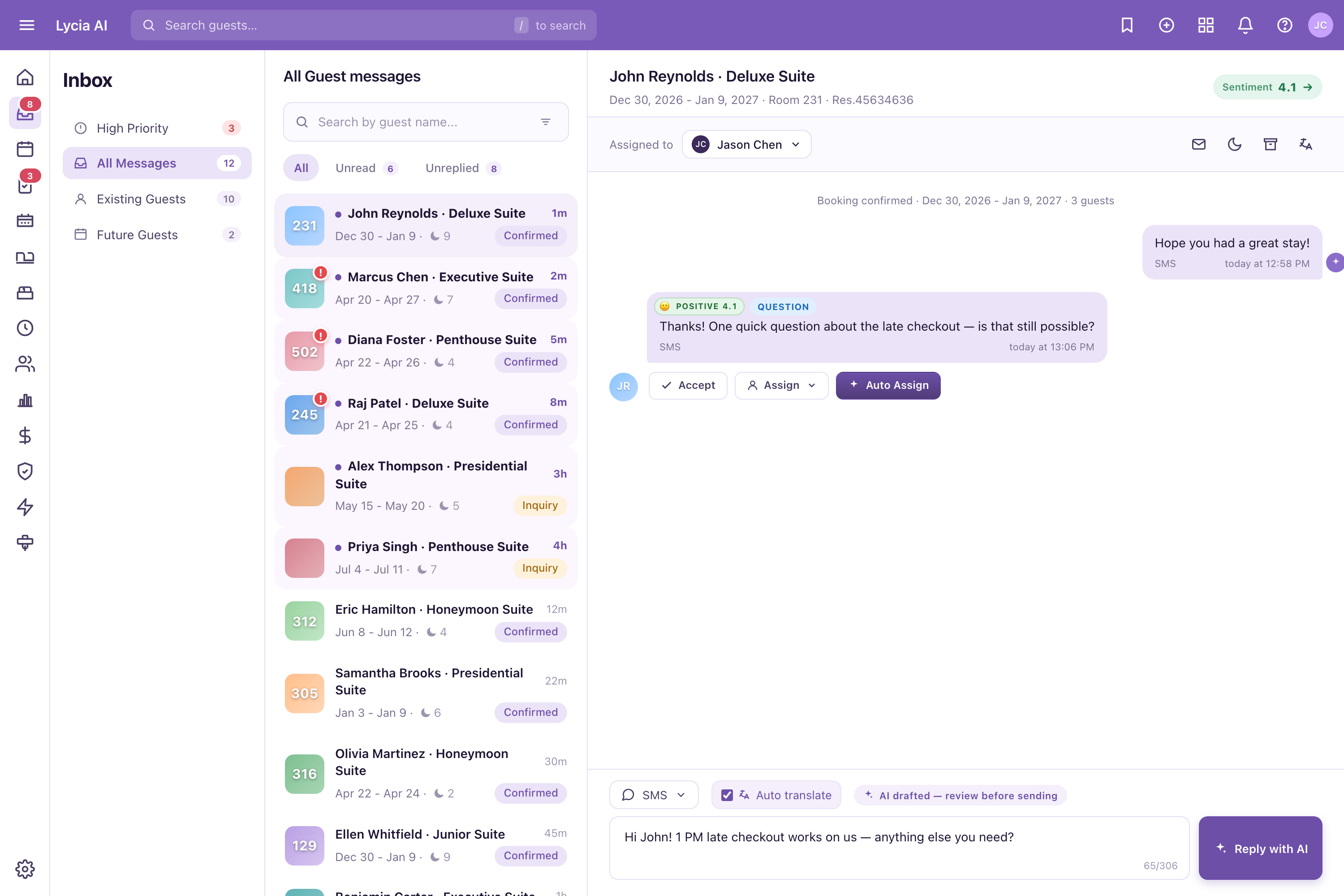
The hardest design problem was trust at the edges of the conversation. The agent had to know when it should answer (most cases), when it should escalate to staff (the right cases), and when it should refuse (the regulated cases). The AI-first inbox โ the staff-side surface where AI-drafted replies, sentiment-driven escalation, and load-balanced auto-assignment all converge โ is the answer we shipped. The case-study deliverable below the outcomes section walks that decision in detail.
The autonomous guest agent. 140+ languages, MCP integration, persistent guest memory, deployed across hotels, airports, malls, restaurants, and offices. Visit the live site for the current marketing surface and the deployment walkthrough.
Visit the product Customer journey ยท 12 pagesA designed 10-step storyboard at a real San Diego boutique property. Booking โ trip planning โ airport โ welcome โ room service โ quick request โ nightlife โ exploring โ transit โ re-engagement one year later. The canonical "what good looks like" for the guest experience the agent enables.
Open the storyboard (PDF)Free for hotels. Revenue from commissions across the network. Two decks per vertical โ one to invite the partner in, one to upsell them their own AI.
A subscription priced at the value Lycia delivers would be expensive. Hotels would resist it, sales cycles would extend, and the long tail would never adopt. The pivot: give the agent away free on the demand side, and capture revenue on the supply side โ when the AI recommends a restaurant, books a music venue, or sells an activity, commission flows back into the network. Hotels deploy with no friction; partners pay for a steady stream of qualified, in-destination demand.
Each supply-side vertical has a paired pitch. The partnership deck sells the partner on joining the network ("we bring the guests to you"). The revenue engine deck upsells them their own Lycia AI for direct customers โ five revenue levers, costed and modeled. Hotels themselves have two pricing experiments: free-with-voice-add-on, and a flat $10/room/month variant that pays for itself with one or two upsells per day.
Demand side ยท two pricing experiments
Supply side ยท partnership + own AI
Two angles on the same question โ does this work in practice? One is customer evidence; the other is a first-person walkthrough of a product decision and what happened after we shipped.
The Beau Hotel (87-room boutique, +$166K projected annual impact). Coastline Kitchen (restaurant, +$42K/mo from network referrals, 14ร ROI on the partnership). Rooftop Social (bar, full 5-lever revenue engine, +$19.2K/mo, 24ร ROI on platform fee). Each case shows what changed, why, and the line-item revenue breakdown. Composite scenarios drawn from aggregate deployment data โ disclosure noted in the document.
Open the case studies (PDF) PM decision ยท 10 pagesFirst-person walkthrough of the decision to rebuild the staff inbox so the AI is the protagonist rather than a sidebar feature. Situation, three options I considered (sidebar / co-pilot / AI-first), what I chose and why, the tradeoffs I accepted, the 30-day outcome (response time โ67%, escalation handle time โ38%, staff inbox NPS 6.2 โ 8.7), and what I'd do differently โ including a sequencing mistake I made early.
Open the case study (PDF)An AI-native PMS for the long tail of independent hotels โ bundled below the agent, designed for the hotels our overlay model can't reach. The thesis, the working concept demo, and the strategy document that argues the case.
The current product needs a PMS to integrate with. That's fine for chains and for the boutique segment that already runs Mews, Cloudbeds, or StayNTouch. It's not fine for the long tail of 5โ50-room independents โ the segment with the most acute staffing pain, and the one most receptive to a single bundled solution. The expansion thesis: build an AI-native PMS underneath the agent, sell the bundle, and capture the segment that's been left out. The deliverable below is the full argument.
Demand side. Deploy Lycia. Earn referral commissions on outbound recommendations to the network.
Supply side. Receive inbound diners from hotel guests + run their own AI for direct customers.
Supply side. Sell tickets and fill weeknight shows via hotel-guest referrals + own AI.
Supply side. Tours, water sports, wine, wellness. Hotel-guest bookings + own AI.
About 25,000 lines of working static front-end with localStorage persistence. Real cross-page data: every entity on a store factory. The architecture (per-entity store factory with uniform CRUD + subscribe API) is designed to swap to a real API when the bundle ships.
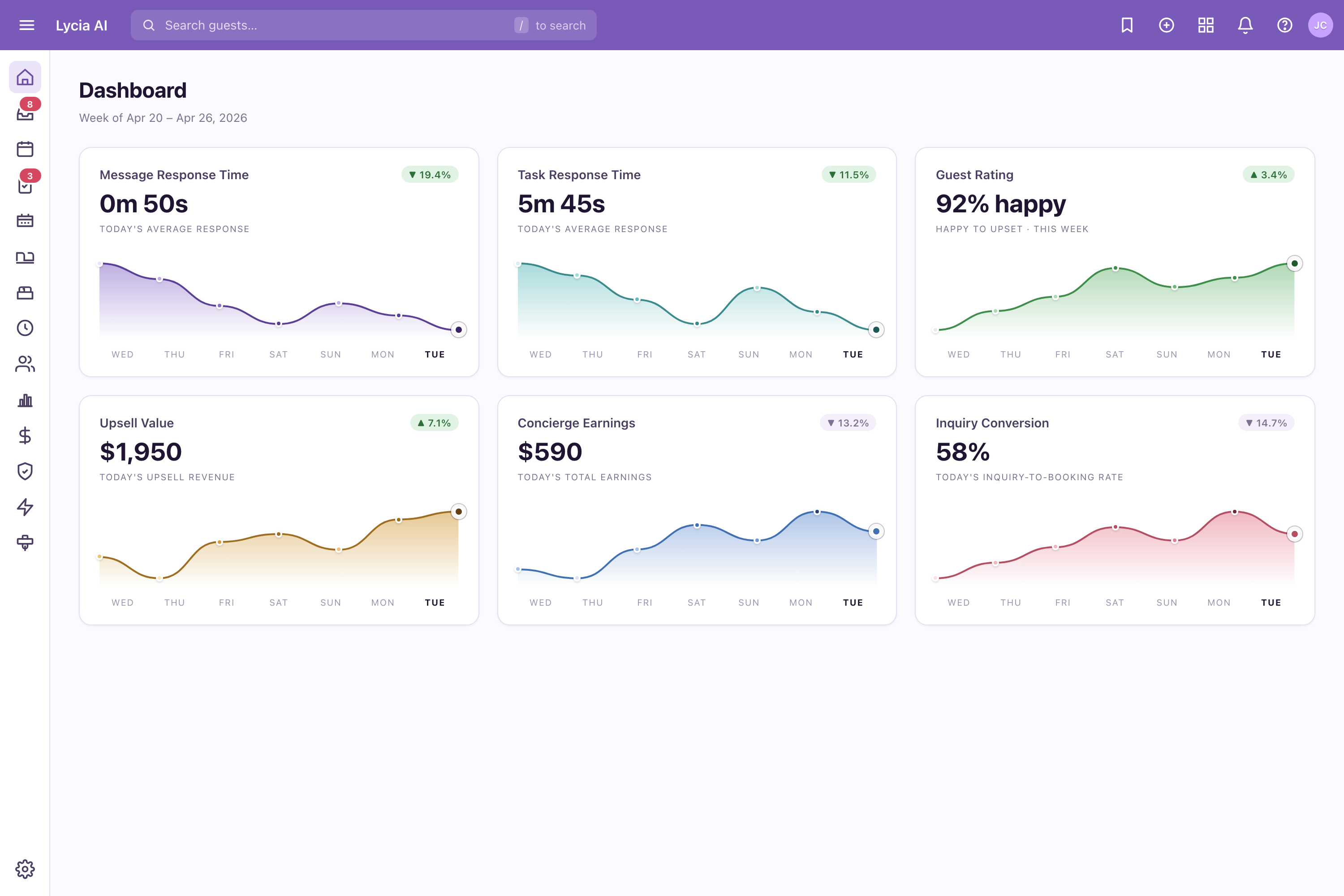
Top-of-funnel landing. Hotel overview, daily briefing, navigation into every operational surface.
โถ Demo surface
Auto-drafted replies, AI category pills, sentiment indicator, escalation banner. Auto-assign to on-duty, eligible staff, load-balanced.
โถ Demo surface
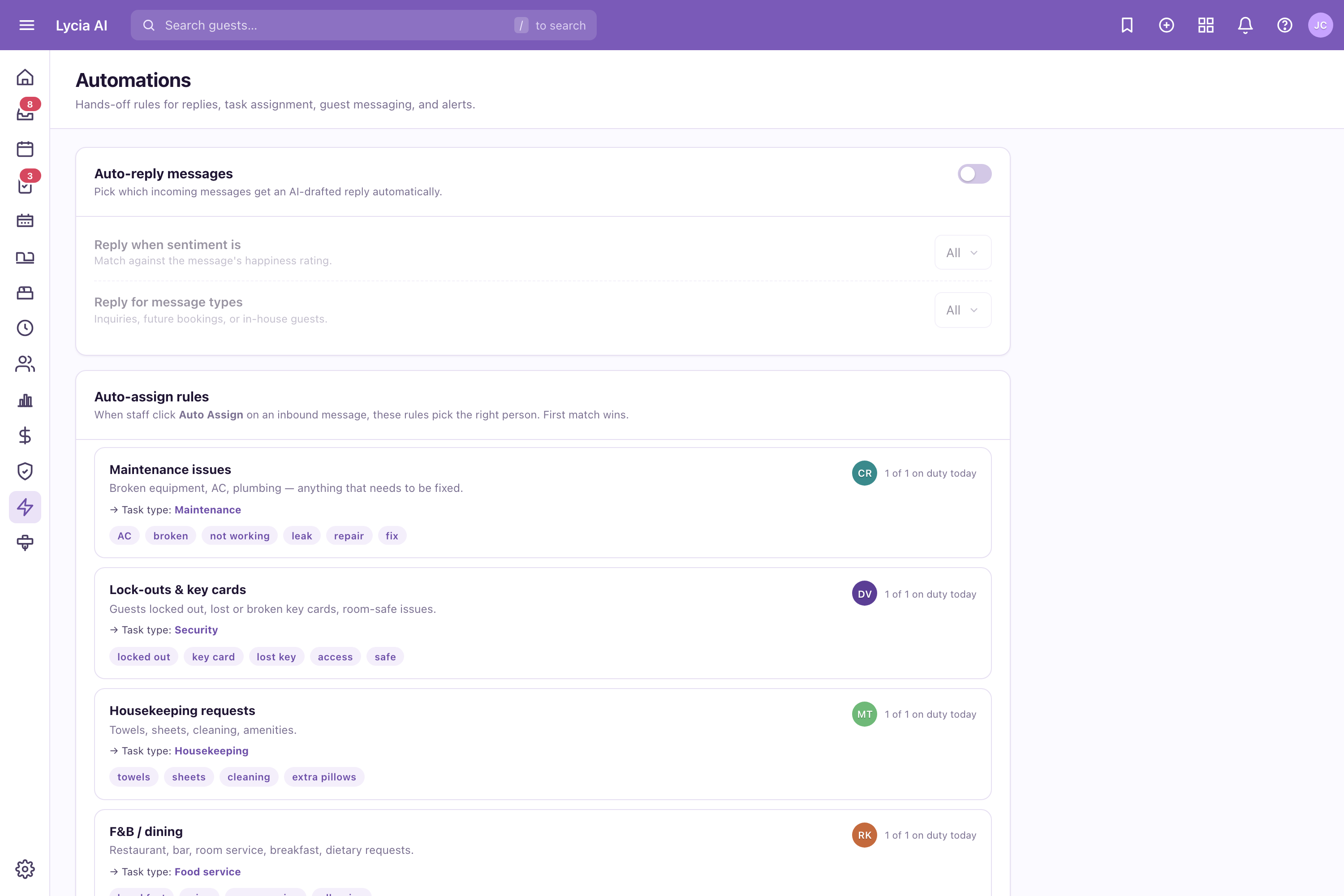
Rules that route AI-detected requests to the right team. The other half of the multi-staff auto-assign behavior.
โถ Demo surface
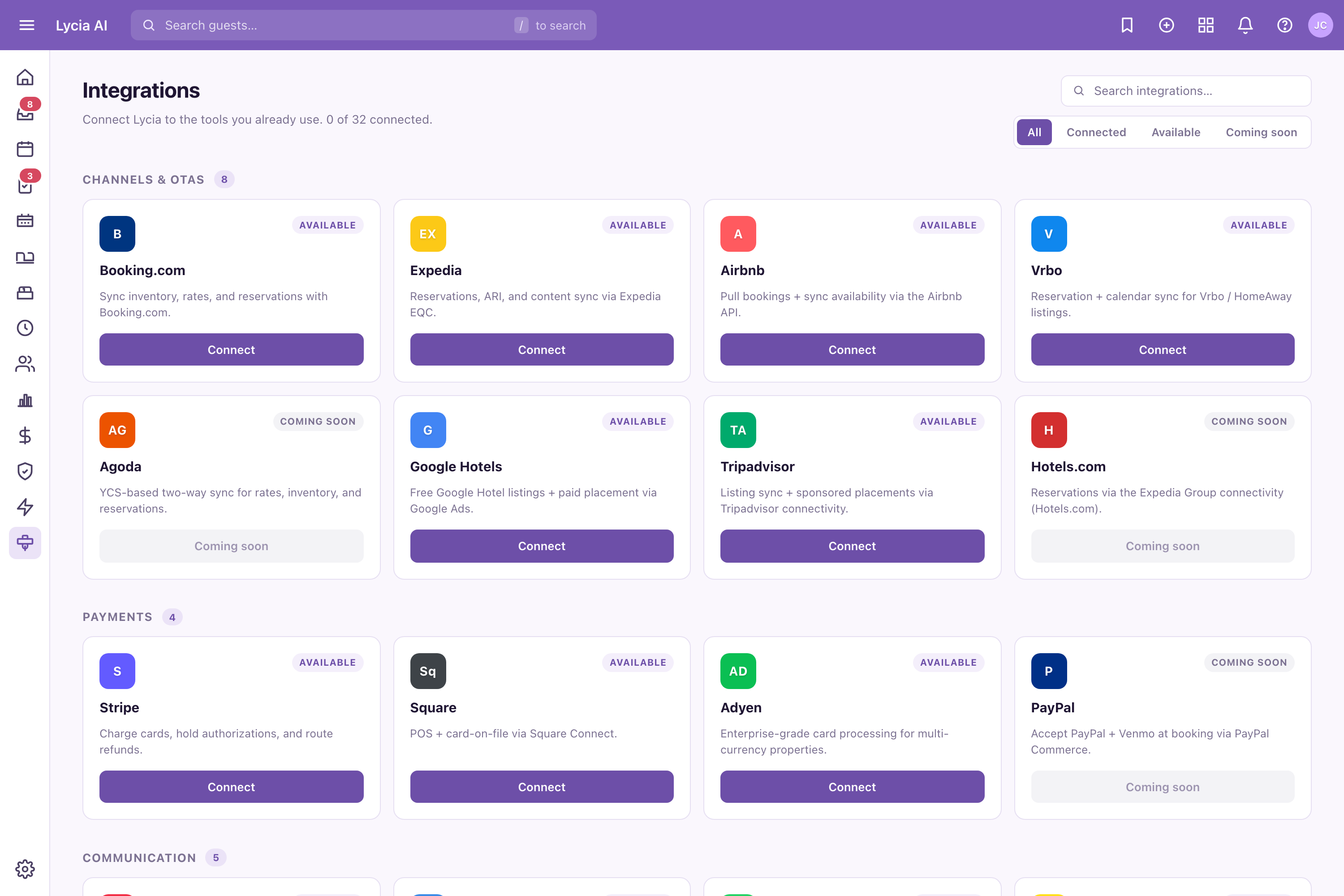
~30 connector cards across 9 categories: OTAs, payments, comms, accounting, door access, revenue mgmt, reviews, identity, smart home.
โถ Demo surface
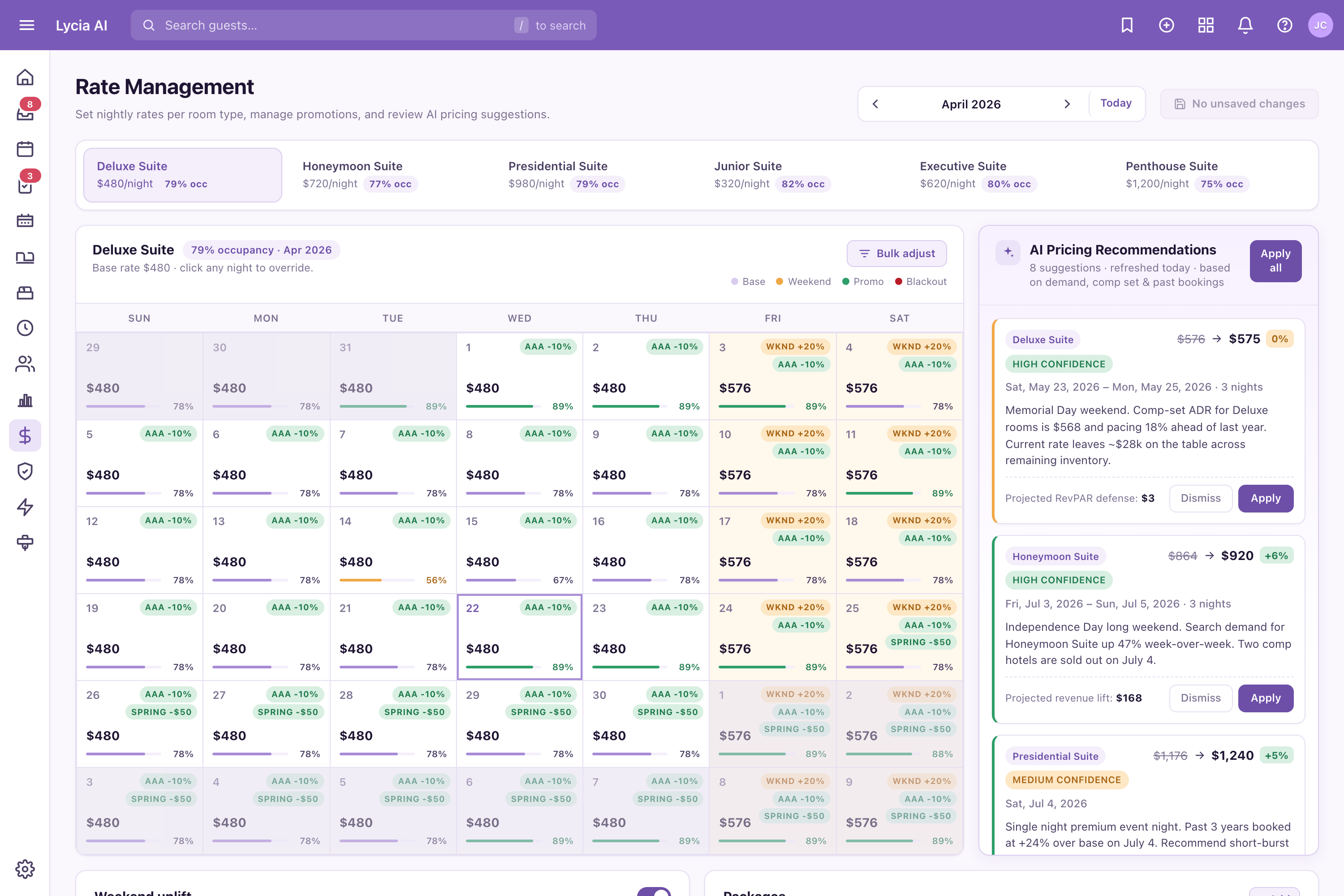
Per-suite rate calendar with date-based overrides. The base for the future rate-recommendation slice.
โถ Demo surface
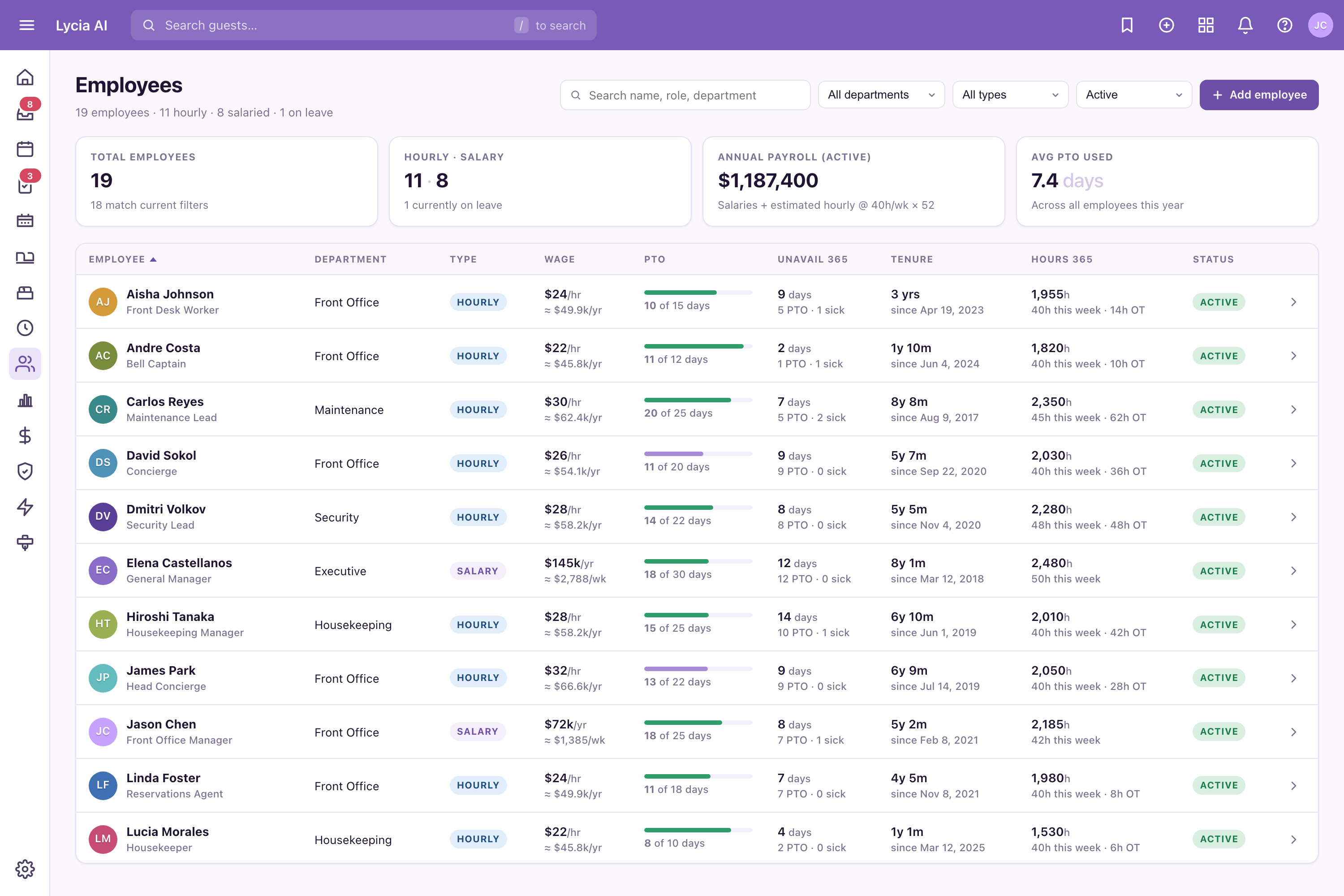
Staff directory with cross-page data: each employee's detail page shows real schedule + tasks pulled from scheduling and task stores.
โถ Demo surface