H Harun Tuncelli
Self-initiated · Built end to end

Two educational products, built from scratch: problem, thesis, research, build plan, and the working app.

MathClash and SplitHomework are self-initiated products. For each one I wrote the thesis, ran the research, drew up the productization build plan, and designed and coded the working app — then deployed it. They're demos, not businesses, and the deliverables say so plainly. Together they're what 0→1 product work looks like when one person owns the whole stack: a problem, the strategy behind it, and a real running thing.

📍 San Diego tuncellih@gmail.com 📞 +1 517 528 6306 🔗 LinkedIn
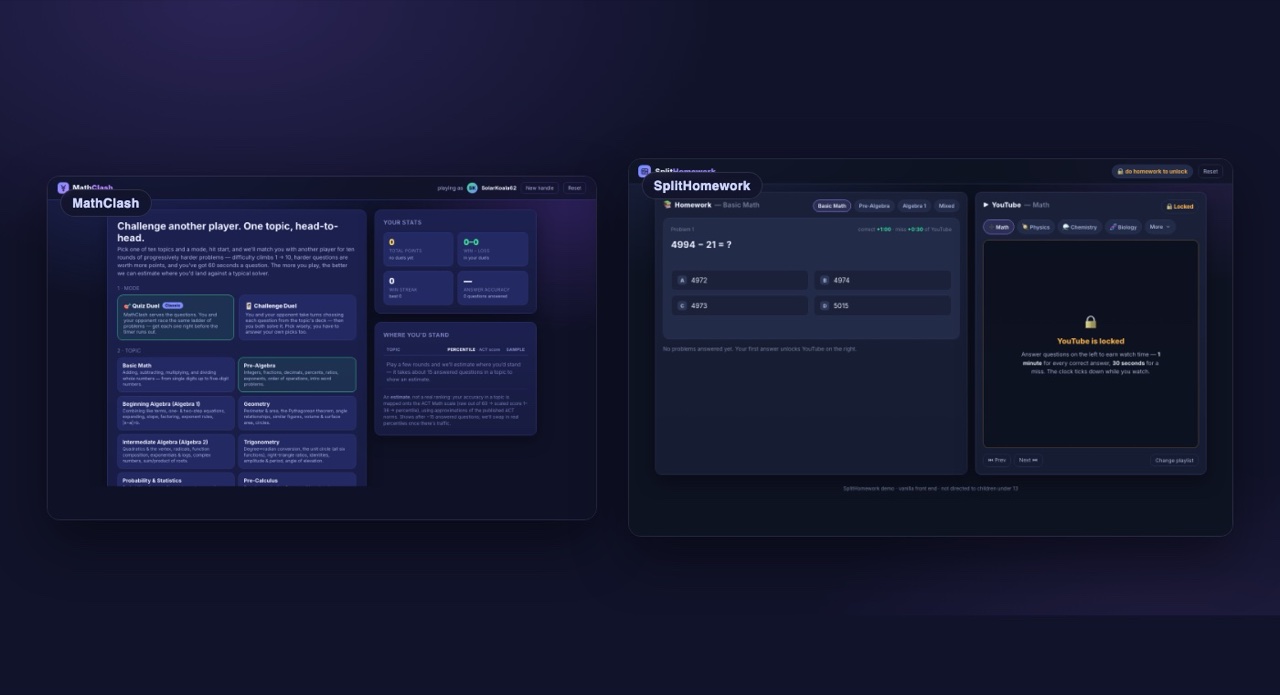
MathClash and SplitHomework — two self-built educational web apps shown side by side
The shape of the work

Two products, built end to end

Same method, two different problems: spot it, sharpen it into a thesis, ground it in research, plan the productization honestly, and ship working software.

MathClash and SplitHomework are educational web apps I built to take a product idea all the way to running software. MathClash is a 1v1 math duel that wraps a real difficulty ladder in low-stakes, near-peer competition. SplitHomework is a split-screen study tool that gates a YouTube feed behind completed homework — built for the phone-shaped attention span, and especially for students with ADHD. Different problems, but the same approach behind both: a narrow claim, the research to back it, a realistic plan to productize it, and a designed-and-coded app that demonstrates the loop.

Each one came with a full set of product artifacts, not just code. For both apps there's a product thesis (one deliberately narrow, falsifiable claim, plus the bets that would disprove it), a research brief (every quantitative claim cited to a real source — what couldn't be verified is flagged, not invented), and a productization build plan (a strategic fork that picks a customer, a gap analysis against the existing tools, a phased roadmap, team and budget, the top risks, and a build-vs-partner call). Then the actual app — UI and front-end code — running live.

The honest framing: these are demos. No users, no efficacy data, scope kept deliberately narrow — and the build plans and research briefs say exactly that. What they demonstrate is the full arc done by one person: noticing a problem, turning it into a thesis, grounding it in real research, planning the productization without hand-waving the cost, and shipping working software — design, code, and the writing in between.
Product one · 1v1 math duels

MathClash

A near-peer, low-stakes math duel wrapped around a real difficulty ladder — and an ACT-style read on where you'd stand right now.

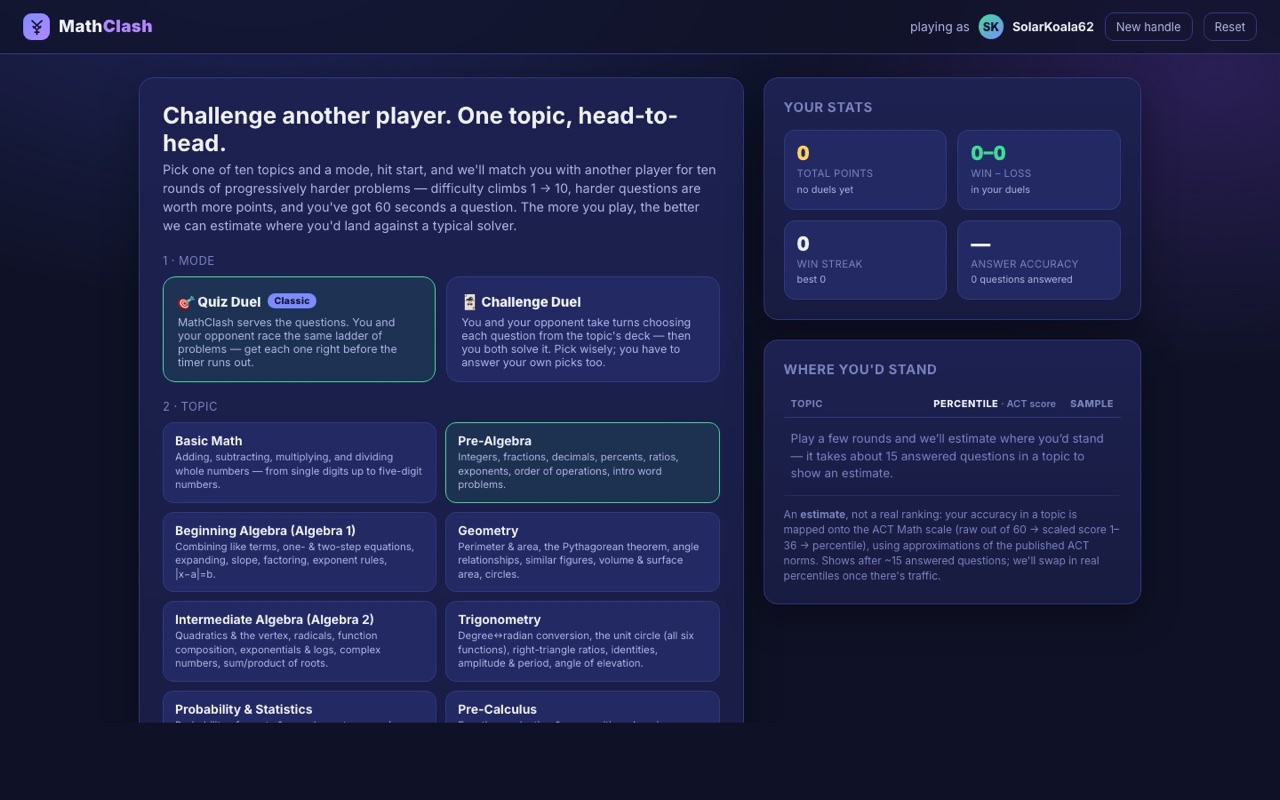
MathClash — pick a topic, then go head-to-head; the home screen with topic grid, your stats, and a 'where you'd stand' panel
Pick a topic, see where you'd stand, then go head-to-head.

MathClash is a 1v1 math duel. You pick a topic, you're matched against another player, and you race each other through a stream of progressively harder questions — difficulty 1 to 10, points scaling with difficulty, a worked solution shown whenever you miss one (with a Skip button), and a one-minute clock per question. After enough rounds it shows an ACT-style "where you'd stand" percentile: your accuracy maps to a raw score out of 60, then a 1–36 scaled score, then a percentile. The opponent is simulated on the player's own machine but presented as a live player.

The thesis it's built around: near-peer, low-stakes, anonymous, repeated 1v1 competition wrapped around a real difficulty ladder is one of the few motivational structures with consistent evidence behind it for confident, high-achieving students — and no consumer product is squarely aimed at the capable kid whose school won't track them and whose family isn't plugged into the talent-search world. The build covers roughly 2,000 generated, correct-by-construction questions with worked solutions across ten topics, the percentile pipeline, and a mobile-friendly UI.

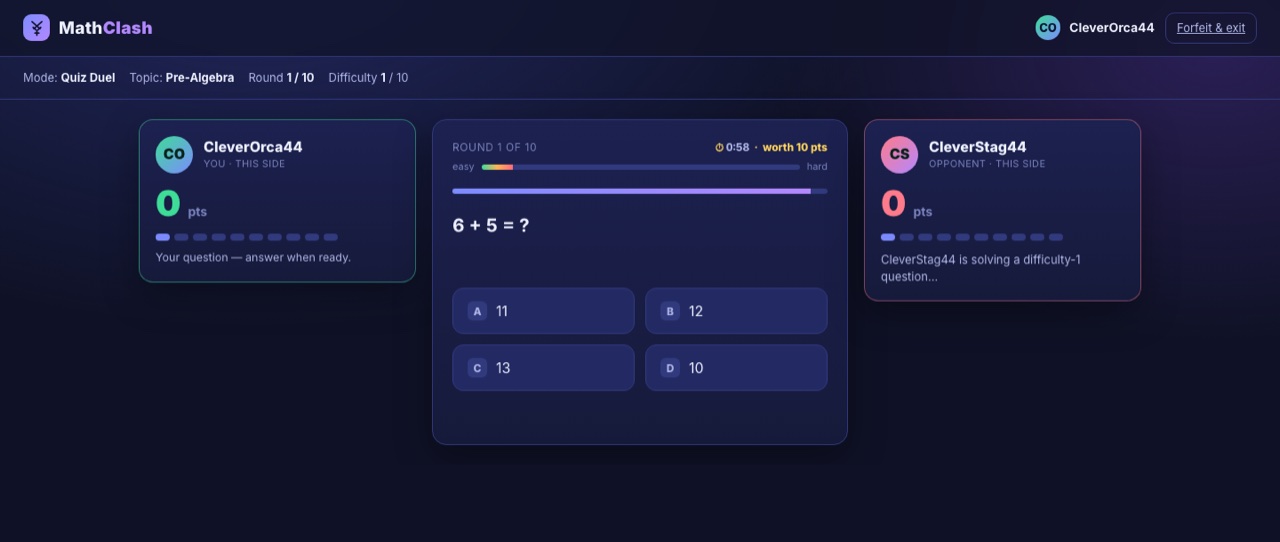
MathClash — a duel in progress: your card, the question with a difficulty bar and per-question timer, and the opponent's card
A duel in progress: difficulty bar, per-question timer, opponent racing alongside.
The deliverables

Three documents behind the app.

Product two · earn your feed by doing the work

SplitHomework

A split-screen study tool: homework on the left earns short, metered bursts of an educational feed on the right — built for the phone-shaped attention span, and especially for ADHD.

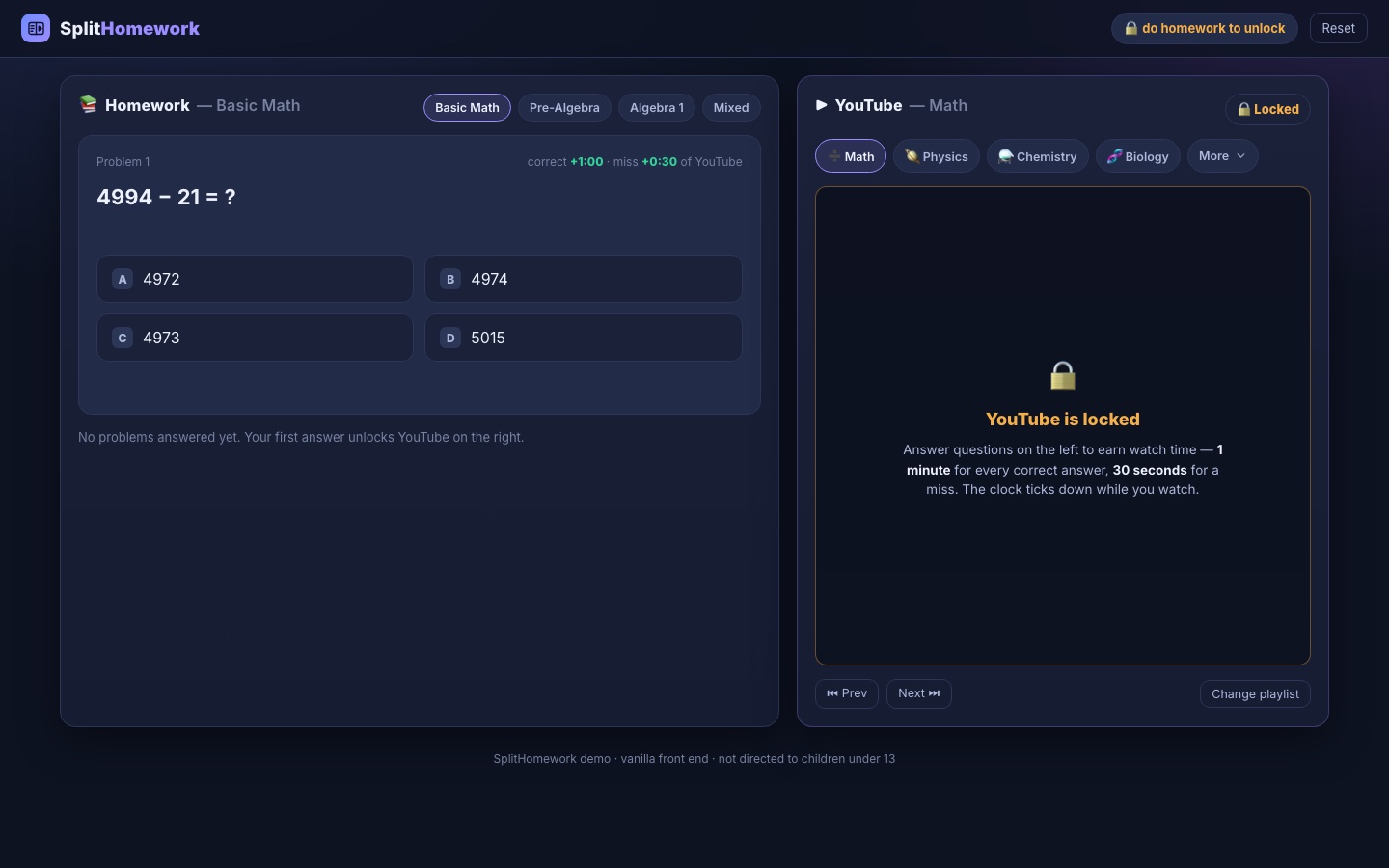
SplitHomework — split screen: a homework problem with four choices on the left, a locked YouTube panel with a category picker on the right
Homework on the left; the YouTube panel on the right stays locked until you earn time.

SplitHomework is a split-screen study tool. Homework on the left — runtime-generated math problems with worked solutions — and a YouTube panel on the right that stays locked until you earn time. A correct answer banks one minute, a wrong one thirty seconds, capped at ten; the clock ticks down while you watch and the panel re-locks at zero. The feed is curated educational playlists across sixteen categories (the sciences, history, languages, and more), reached from a few quick-pick chips plus a custom dropdown.

The thesis it's built around: short-form video has trained a generation's reward system to expect fast, frequent payoffs, and for students with ADHD the mismatch with slow, low-feedback schoolwork is the wall they hit nightly. Rather than fight that wiring with abstinence, SplitHomework channels it — the instant-reward feed is gated behind completed schoolwork, which is the contingency-management / Premack ("first, then") structure with the strongest evidence behind it for this population. It's framed as lowering the activation energy to start and re-engage with homework — the real ADHD pain point — not as "training multitasking," which the literature does not support. The research brief grounds each claim in a real source and is explicit about what isn't proven.

The deliverables

Three documents behind the app.

Why it's in the portfolio

What this work demonstrates

Not "look at these businesses" — they aren't. It's how I take something from a problem to a shippable product when I own the whole stack.

The full 0→1 arc, done by one person. Problem → thesis → research → build plan → designed-and-coded app → deployed. Each of these is a real running thing with the strategy work in front of it, not a deck about a product that doesn't exist. The same loop I'd run inside a company — just compressed, and visible end to end.

Discipline in the writing, not just the code. The research briefs trace every quantitative claim to a real URL and flag the things that couldn't be verified rather than inventing them. The theses are written as one narrow, falsifiable claim with the bets that would disprove it. The build plans pick a customer, name the gap honestly, and don't hand-wave the cost or the risk — including, for SplitHomework, the uncomfortable fact that the in-app lock is bypassable and a real version needs a browser-level block, which the plan says outright.

And an honest sense of scope. These are demos: no users, no efficacy data, deliberately narrow. The point is the method — spotting a problem, sharpening it, grounding it, planning it without illusions, and shipping working software — and the range it covers: product thinking, research, strategy, UI design, and front-end code, in one person's hands.

Two products, six documents, two live apps. MathClash and SplitHomework are small on purpose. What's not small is the path each one walks: a problem worth solving, a thesis you could prove wrong, research that cites its sources, a build plan that picks a customer and counts the cost, and a working app at the end of it. That path is the portfolio piece.